
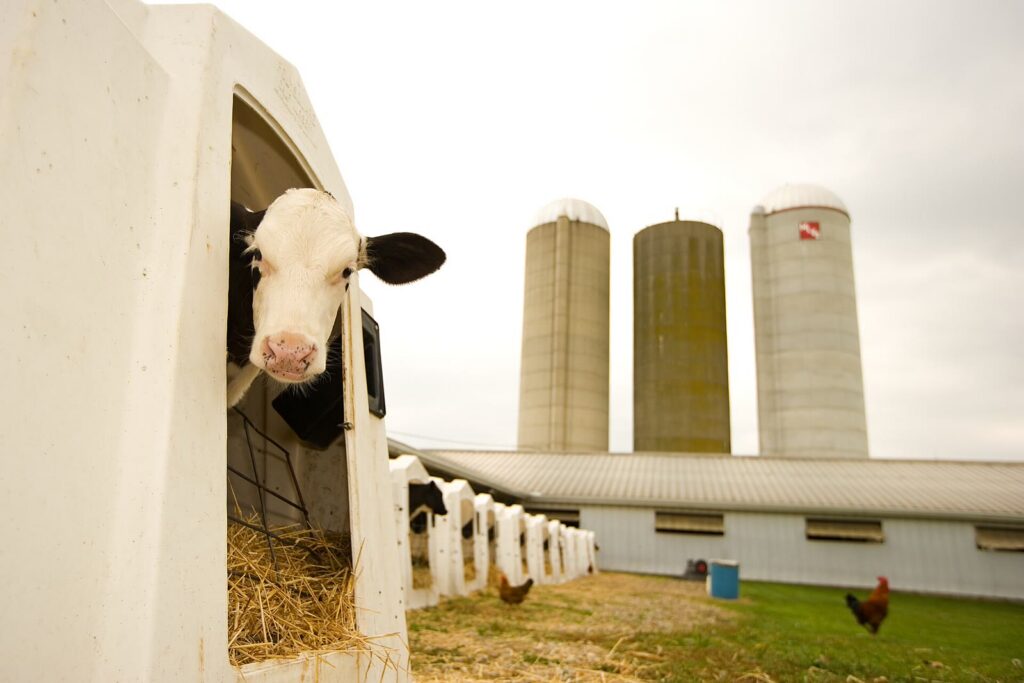
Calf exports keep Europe’s dairy and beef chain moving: a herd that calves for milk rarely has the space, labour or feed to rear every animal it produces, while a rearer or fattener a few hundred kilometres away may be short of young stock all year. This post looks at why calves cross borders inside the EU, which flows matter to a seller, and where a Polish buyer fits into that picture.
Why calf exports exist at all
A dairy cow has to calve to milk. Around half of those calves are bulls, and many of the heifers are surplus to the herd’s own replacement needs. A specialised dairy farm is built for milking, not for rearing bulls, so the young stock has to go within weeks. In regions with dense dairy herds, local demand can’t absorb all of it, and the calves travel to farms that rear or finish cattle for a living.
Beef farms sell for a similar reason: a suckler herd may wean more stock than it can finish. Either way, one farm has the animals and another has the sheds and feed to take them further.
Seasonality adds pressure. Herds that calve in a tight spring block put many calves on the market within a few weeks, and a seller with a reliable outlet abroad is better placed than one relying on the local mart that day.
Main flows inside the EU
Without quoting volumes, the broad pattern is well known in the trade. Calves move from member states with large dairy herds and limited rearing space towards countries with rearing and fattening capacity. Ireland, the Netherlands and Germany are typical sources of dairy and dairy-cross calves. Central and Eastern European countries, including the Baltic states, Czechia, Slovakia and Hungary, supply both dairy calves and beef or cross-bred stock, often over shorter road distances to Poland.
Buyers fall into three groups, veal rearing, beef fattening and replacement heifers, and each wants a different animal. A veal unit looks for young, light dairy bull calves in large even batches. A fattener wants calves for fattening that will finish well, and often prefers beef crosses. A dairy farm buying replacements cares about genetics and health status first.
For anyone who wants hard numbers, intra-EU trade in live bovine animals is reported by Eurostat (Comext database) and by national statistics offices. As of October 2026 we point sellers to those sources rather than repeating figures that change every quarter. We wrote up the direction of the trade towards Poland in more detail in our earlier piece on EU calf flows into Poland, and the practical side of dealing between member states is covered in how trade between member states works day to day.
Where Poland fits as a buyer market
Poland is a destination market for young stock. Polish farms buy calves from abroad to keep sheds full, so a Polish buyer usually wants regular lots, not a single load. We buy in eleven countries, and each one has its own page on where we source calves, with the local certifying authority, the papers we expect and a supplier form in the local language. Irish sellers, for example, can see the DAFM side of the process on the Ireland supplier page.
What we buy falls into three groups: dairy replacement calves (heifers), bull calves for fattening, and weaned calves. As an indication only, dairy calves sit around 52–90 kg, starter calves around 110–150 kg, and weaned or stocker calves (beef breeds only) around 220–350 kg. The exact spec is agreed per lot, so treat those ranges as a starting point for the conversation, not a rule. Holstein Friesian remains the backbone of the dairy side, and the Holstein Friesian breed page sets out what we look for in a lot of those calves.
What a calf export lot needs before it leaves the farm
Most failed loads fail on paperwork or timing, not on the calves. Before anything moves, check these points:
- Identification. Every animal carries its ear tags and has a bovine passport or identification document. Ear-tag numbers should already be in your first offer.
- Health certificate. The EU INTRA animal health certificate is created in TRACES NT and certified by the official veterinarian before dispatch, under Delegated Regulation (EU) 2020/688. No loading before the certificate is issued.
- Transport. The journey runs under Council Regulation (EC) No 1/2005: an authorised transporter, an approved vehicle, a driver with a certificate of competence, and a journey log for long journeys.
- Lot size. Our minimum is 28 head for TYPE 1 transport (up to 8 hours’ drive) and 150 head for TYPE 2 (long distance, trailer).
The legal references above are as named by EUR-Lex and the European Commission, as of October 2026. Disease rules can change at short notice, so your official vet has the final word on the certificate.
How the deal is usually set up
We buy on an EXW basis: we collect the calves at your farm or collection point with our own trucks. You don’t arrange haulage. Prices and payments are in EUR. There is no price list. The price per head is agreed per lot, because two lots of the same breed can differ a lot in weight spread, age and paperwork.
Payment terms and the size of a trial lot are agreed with each supplier before the first loading. That first lot matters more than any brochure. It shows both sides whether tags match passports, the certificate was ready on time, and the calves on the lorry match the offer. The full sequence, from offer to loading, is set out on how we buy calves, and the supplier FAQ answers the questions we hear most from new sellers.
Sending a first offer
A good first offer is short and specific: country, breed or cross, sex, number of calves per month, age and weight, ear-tag numbers, and which documents are ready. We speak Polish, Russian and English, so you can write in whichever suits you. If you already ship calves abroad and want a second outlet, or you are looking at calf exports for the first time, start with the supplier form on our contact page, or read what we expect from long-term partners first.
You can also call or WhatsApp +48 691 900 728, or email biuro@eurocieleta.pl, Monday to Friday during business hours (Warsaw time).