
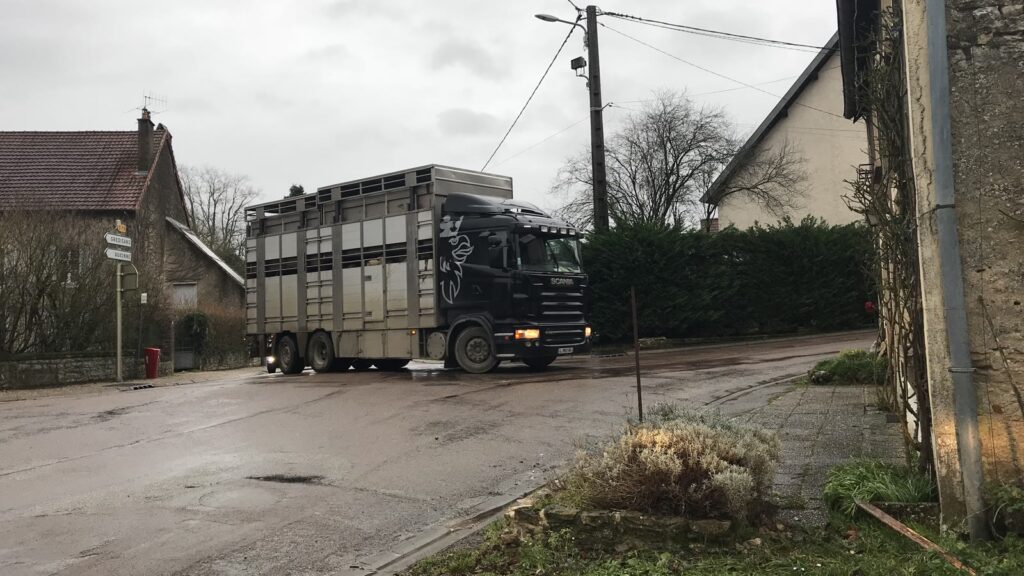
Livestock transport requirements in the EU change at one line on the clock: eight hours. Below it, a calf lot travels under the rules for a short journey. Above it, the same calves need a different authorisation, an approved vehicle, a journey log and satellite tracking. For a seller it decides which lot size we ask for, which truck comes to your yard and how much planning happens before loading day.
The broader rulebook is covered in our supplier checklist on calf transport rules; here we stay with what changes between a short and a long journey.
Where the 8-hour line comes from
Council Regulation (EC) No 1/2005 defines a long journey as one that exceeds 8 hours, counted from the moment the first animal of the consignment is moved. The clock starts when the first calf walks up the ramp, not when the truck leaves your gate, so a slow loading eats into the same eight hours as the motorway.
Two kinds of transporter authorisation follow from that definition. Article 10 covers transporters on journeys up to 8 hours, and that authorisation is not valid for long journeys. Article 11 covers long journeys and asks for more, including certificates of competence for all drivers and attendants and approval certificates for every road vehicle. On many national forms they are called Type 1 and Type 2 authorisations.
Our own lot terms borrow the same names. On the trade terms page you will see TYPE 1 for transport up to 8 hours’ drive, with a minimum of 28 head, and TYPE 2 for long-distance transport by trailer, with a minimum of 150 head. The lot sizes are not arbitrary. A long journey carries fixed planning and paperwork that only make sense for a full trailer.
Livestock transport requirements on a short journey (TYPE 1)
A short journey still has rules. Every consignment needs transport documentation on board stating origin and ownership, place of departure, date and time of departure, intended destination and expected duration. The transporter needs an authorisation. Drivers and attendants of bovine animals need a certificate of competence.
Fitness for transport applies on every journey, short or long. Calves under ten days old may not be transported unless the trip is under 100 km, and newborn calves with an unhealed navel are not fit at all. That rule alone keeps the youngest dairy bull calves out of cross-border trade.
For a seller close to the Polish border, TYPE 1 is the simpler route. A lot of 28 head or more is collected at your farm or collection point, loaded once the EU INTRA health certificate is issued in TRACES NT, and goes straight to Poland. Whether your yard falls inside the 8-hour window depends on the real route, loading time included, not a straight line on the map. Our supplier country pages list where we buy now.
What a long journey adds (TYPE 2)
Past 8 hours, the regulation adds obligations for the transporter and organiser that a seller will still notice.
Approved vehicle and navigation
No road vehicle may be used for a long journey unless it has been inspected and approved by the competent authority. The vehicle must carry a navigation system, and the transporter keeps those records for at least three years. That is why a long-distance lot comes on a specific approved trailer.
Journey log
For long journeys of cattle between member states, the journey log in Annex II of the regulation applies. Section 1 is the planning part, filled in before departure, and the competent authority at the place of departure checks it before a long journey. Wrong loading times or a missing rest point stop the journey before it starts, so your headcount, loading time and exact address feed straight into it.
Rest and watering intervals
Annex I sets the intervals. Unweaned calves still on a milk diet must get at least one hour of rest after nine hours of travel, enough to be given liquid and fed if needed, and may then travel for a further nine hours. Other cattle may travel 14 hours, rest for at least one hour, then travel another 14. After the maximum time, animals are unloaded, fed, watered and rested for 24 hours. With young dairy calves, the route is planned around the calves, not the driver’s preferred stop.
What sellers should prepare for each journey type
The documents for the calves are the same in both cases: ear tags on every animal, a bovine passport or identification document for each one, and the EU INTRA animal health certificate certified in TRACES NT before dispatch. No loading takes place before the certificate is issued. What changes is how early we need information from you.
- For a TYPE 1 lot: headcount, age, weight and ear-tag numbers, the loading address and realistic access for a livestock truck.
- For a TYPE 2 lot: the same, plus a firm loading window, because the journey log and rest points are planned backwards from it.
- For both: calves grouped by weight class so compartments can be set correctly; our post on space per head and lot sizing shows how that works.
The weight ranges on our site are indicative (dairy calves 52 to 90 kg, starter calves 110 to 150 kg, weaned beef calves 220 to 350 kg), and the final spec is agreed per lot. Young Holstein Friesian calves are where the long-journey intervals matter most, so age at loading is the first thing we discuss.
Who carries the transport obligations
We buy EXW and collect with our own trucks, so the transporter authorisation, the vehicle approval, the driver certificates and the journey log are our side of the job. Your part is the animals, their ID, the health certificate and an honest description of the lot. Price per head is agreed per lot, in EUR. Collection and document questions are answered in the FAQ, and the partner overview explains how regular cooperation is set up.
In December 2023 the European Commission proposed a regulation to replace 1/2005. It has not been adopted, so 1/2005 still applies to every lot we collect.
Sources: Council Regulation (EC) No 1/2005, Articles 2, 4 to 6, 10, 11 and Annexes I and II, consolidated text on EUR-Lex; European Commission proposal COM(2023) 770 on the protection of animals during transport. As of 16 November 2026.
Have a lot ready and unsure whether it is a short or long journey? Send the details through the supplier offer form, call +48 691 900 728 or write to biuro@eurocieleta.pl.