
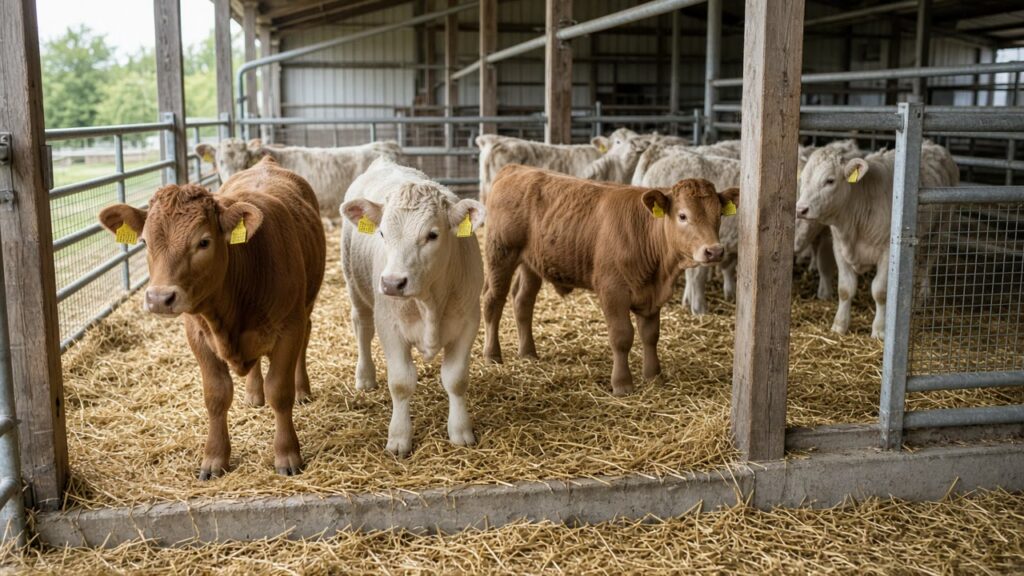
Bull fattening is decided long before the first ration is mixed. A fattening unit can have good feed, good housing and a good vet, and still lose months because the calves that came in were uneven, under-documented or simply the wrong type for the system. For anyone selling bull calves, that is the useful starting point: the fattener is not buying animals, he is buying a predictable start to a long cycle.
This piece looks at the supply side only: what a fattening farm in Poland needs to see in a lot of calves from abroad, and how a seller can prepare that lot so it is accepted at the first conversation, not the third.
What bull fattening farms actually buy
Most fatteners buy into one of three entry points, and each one asks something different of the seller.
Young dairy bull calves. Typically Holstein Friesian or dairy crosses, bought young and reared on. On our side, dairy calves are bought in an indicative range of 52 to 90 kg. More on the breed is on the Holstein Friesian page.
Starter calves. Calves that are past the most delicate early weeks and ready to move onto a fattening ration. We work with starters in an indicative range of 110 to 150 kg. The animals arrive closer to the point where the farm’s own system takes over.
Weaned calves. Beef-breed animals in the 220 to 350 kg range (again indicative), for farms that want a shorter finishing period on their own feed. The trade-offs of this stage are covered in our post on weaned calves and when they make sense.
All three ranges are guides, not a fixed specification. The actual spec, from weight window to age spread, is agreed per lot with each supplier before anything is loaded.
Breed and type: what fatteners ask about first
The first question from a fattening farm is usually what the calves are, not what they weigh. Beef genetics and beef-on-dairy crosses are in demand because they put muscle where the buyer of the finished animal wants it.
Limousin brings muscular French beef genetics with a usable finishing frame; the Limousin breed page describes what we look for. Charolais is a large-framed French beef breed that some farms want and others avoid, depending on how long they keep the bulls; see the Charolais page for detail. Belgian Blue crosses are valued for muscling, and Simmental is a dual-purpose breed widespread in Central Europe.
Dairy bull calves still have a firm place in bull fattening. What matters is that the lot is described honestly: if a group is mostly Holstein with a few crosses mixed in, say so.
Evenness matters more than a single good animal
Fattening works in groups. Calves are penned, fed and managed together, and a group that starts uneven stays uneven. The lightest animals get pushed off the feed face and the heaviest finish early.
That is why fatteners look at the spread within a lot as closely as the average. When you offer calves, the useful information is:
- breed or cross for each animal, or at least the share of each type in the lot;
- sex, since bull fattening farms usually want bulls only, not mixed groups;
- age and weight, ideally per animal, with the ear-tag numbers;
- how the calves have been fed so far, and whether they are already on solid feed;
- any treatments given and the general health history of the group.
A lot sorted by type and weight before collection is far easier to place than a mixed group the buyer has to sort himself.
Papers, transport and lot size
None of the above helps if the documents are not ready. Every calf must be individually identified with ear tags and have its bovine passport or identification document. Before the truck leaves, the official veterinarian in the country of origin certifies the EU animal health certificate for intra-EU movement in TRACES NT. No loading happens before that certificate is issued. Our buying terms and loading requirements list the full set.
Transport is not the seller’s job. We buy EXW, at your farm or collection point, and collect with our own trucks, run under Council Regulation (EC) No 1/2005 on the protection of animals during transport. Price per head is agreed per lot and paid in EUR; there is no published price list.
Lot size follows the transport type. For journeys of up to 8 hours’ drive (TYPE 1), the minimum is 28 head. For long-distance transport by trailer (TYPE 2), the minimum is 150 head.
Why regular supply counts for bull fattening
A fattening farm plans its pens months ahead. When one group goes out to slaughter, the next one should already be lined up. A seller who can deliver a similar lot at regular intervals becomes part of that planning rather than a one-off purchase.
The demand side is covered in our post on what drives demand for fattening calves in Poland. Here the point is simpler: steady lots of a consistent type turn a single sale into ongoing cooperation. Trial shipments are welcome, and payment terms and the size of a first lot are agreed individually before the first loading.
We buy in eleven countries; the supplier countries overview shows each one with the certifying authority and typical papers. The background on our company explains who is buying.
How to offer bull calves for fattening
The fastest way to get a clear answer is to send a complete offer in one go. State the country, the number of calves and how often you can supply them, breed or cross, sex, age and weight per animal with ear-tag numbers, and which documents are ready. You can do it through the supplier offer form, by phone or WhatsApp on +48 691 900 728, or by email to biuro@eurocieleta.pl. We answer in English, Polish or Russian.
If you are weighing up a longer partnership rather than a single lot, the partner requirements page sets out what Euro Cieleta expects from regular suppliers and what the cooperation looks like in practice.