
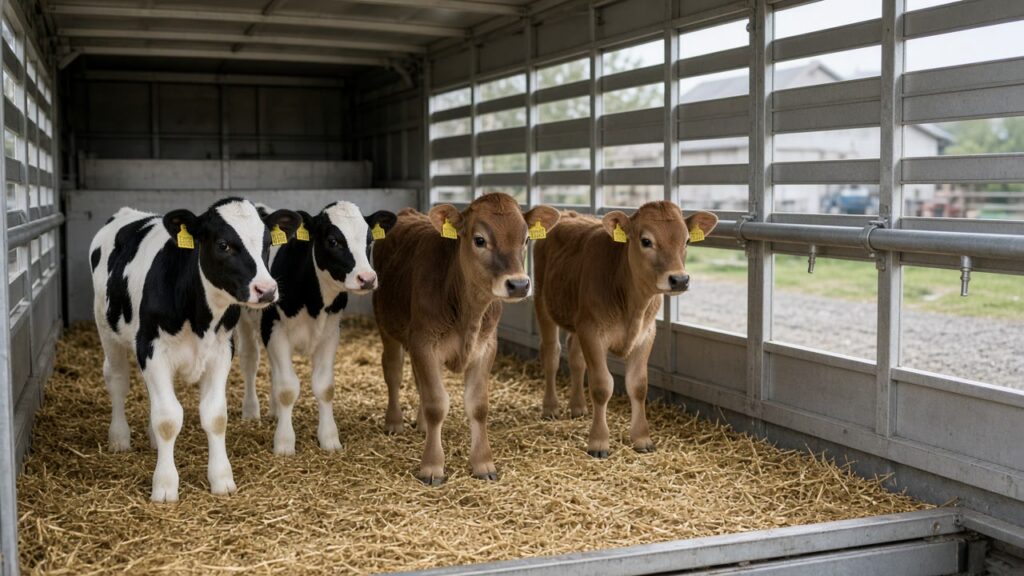
Calf shipping fever is the respiratory disease that shows up a few days after a lot has been moved, mixed and stressed, and it is the reason a buyer asks so many questions about calves before they go on a truck. For a seller, it matters less as a diagnosis and more as a planning problem: most of what lowers the risk happens on your farm, in the week before loading.
What follows is practical seller preparation, not veterinary advice. Treatment and vaccination plans belong to your own vet.
What calf shipping fever actually is
“Shipping fever” is the old field name for bovine respiratory disease (BRD) that follows transport. It is not one germ. Veterinary references describe it as a complex: stress and a viral infection weaken the calf’s airways, and bacteria such as Mannheimia haemolytica and Pasteurella multocida then cause pneumonia. The viruses usually named in that chain are BRSV, PI3, IBR and BVD.
The stress side is what makes transport so relevant. Weaning, a change of feed, mixing calves from several farms, handling, crowding, temperature swings and hours without water all pile up in a short window. Signs typically appear within the first one to two weeks after arrival: dull eyes, nasal discharge, cough, reduced intake and fever.
For the rearing farm, BRD after delivery means treatment costs, slower growth and sometimes losses, so a serious buyer cares about the calves’ history, not only how they look on loading day.
Why long journeys raise the risk
Distance on its own is not the problem. What comes with it is: longer time off feed and water, more handling, and more chance of calves from different sources sharing a deck.
EU law sets the frame for this. Council Regulation (EC) No 1/2005 on the protection of animals during transport says that only animals fit for the intended journey may be moved, and it rules out, among other cases, calves with an unhealed navel and calves under ten days old on journeys over 100 km. For unweaned calves on long journeys it requires a rest period of at least one hour after nine hours of travel, during which they must be given liquid and, if necessary, fed, before the journey continues. The European Food Safety Authority’s 2022 scientific opinion on the welfare of cattle during transport identifies unweaned calves as a particularly vulnerable group. (Sources: Council Regulation (EC) No 1/2005 and the EFSA opinion on welfare of cattle during transport, as of 2 November 2026.)
This is also why our minimum lots are split by journey type. A TYPE 1 collection, up to 8 hours’ drive, needs at least 28 head. A TYPE 2 collection is long-distance transport with a trailer and needs at least 150 head. On a long journey the transporter must also carry a journey log, and the driver needs a certificate of competence. All of this is described on our how we buy page, and the wider legal picture is covered in our post on the EU rules for moving calves by road.
Preparing a lot to reduce shipping fever
Start with colostrum and early health
A calf that had enough good colostrum in its first hours carries that protection into the trade. A calf that did not will be the first to go down after a journey. Keep records of birth dates and treatments, and check every calf meets the minimum age for the journey.
Keep calves together and settled
Mixing is one of the strongest stress factors. If you buy in from several farms, group the calves several days before loading rather than meeting them at the ramp. Avoid weaning, castration, dehorning or a feed change in the days just before collection. Each of these is one more load on the calf.
Talk to your vet about a plan
Whether and when to vaccinate against respiratory viruses is your herd vet’s call. A buyer simply wants to know what was done, with dates.
Pick the calves honestly
Leave out any calf that is coughing, has a temperature, a wet navel or diarrhoea. Filling the lot to the agreed number with a sick calf puts the rest at risk,.
Make loading day boring
Feed and water as normal, keep handling quiet, and have the lot penned near the loading point. Calves chased across a yard in the rain start the journey already stressed.
What the buyer checks on collection
On our side, price basis is EXW: we collect at your farm or collection point with our own trucks, so you don’t arrange the transport. Conditions on board are then our responsibility.
What we need from you is a lot that is fit to travel and fully documented. Every calf must carry its ear tags and have its passport or identification document. An EU INTRA animal health certificate is created in TRACES NT and signed by the official veterinarian before dispatch, and there is no loading before the certificate is issued. The health papers we check before a lot leaves are explained in a separate post.
Weight is part of the same picture. Our published classes are dairy calves at 52–90 kg, starter calves at 110–150 kg and weaned or stocker calves (beef breeds only) at 220–350 kg. These ranges are indicative; the exact spec is agreed per lot, together with the price per head in EUR. Younger, lighter calves, such as Holstein Friesian bull calves, need the most care on the road, which is one more reason to agree age and weight in writing before the first loading.
Sending an offer for a transport-ready lot
If your calves are prepared this way, say so in the offer. Useful details are the age and weight range, ear-tag numbers, breed and sex, how many calves you can supply per month, the vaccination and treatment record, and how long the calves have been grouped together.
Euro Cieleta buys calves in eleven countries for Polish rearing and fattening farms; the list of supplier countries shows which local authority issues the certificate in yours. Common questions about lot sizes and documents are answered in our FAQ for calf suppliers, and if you want to work on a regular basis, the partner page explains how cooperation starts. To send a lot today, use the supplier offer form, call or WhatsApp +48 691 900 728, or write to biuro@eurocieleta.pl.