
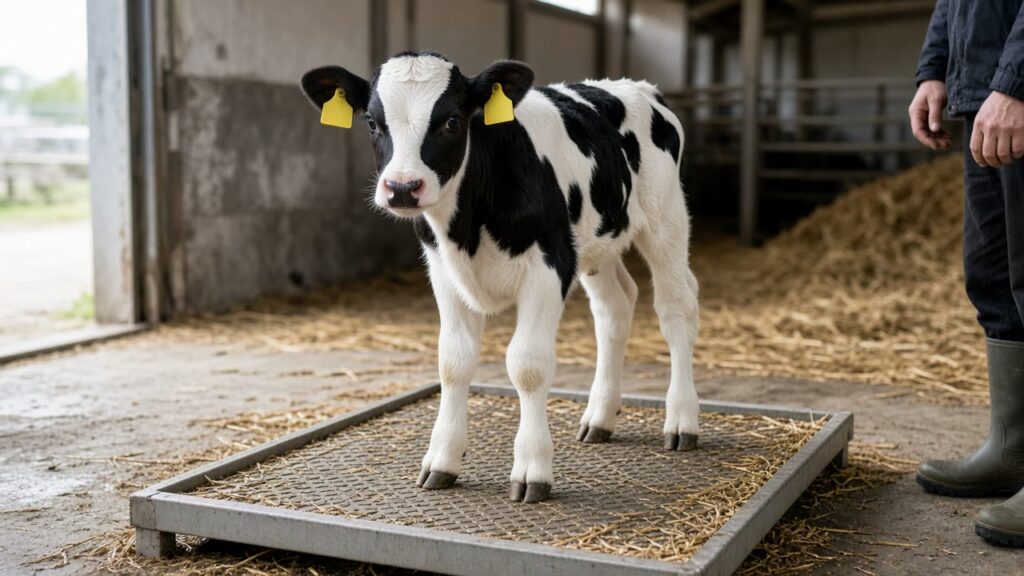
Holstein calf weight is the number most sellers think they know and fewest actually measure. Ask a dairy farmer what his bull calves weigh at three weeks and you will hear “about 60”. Put the same calves on a scale and the pen often runs from 48 to 75 kg. That spread decides how a buyer groups, feeds and values the lot, so it pays to know where a Holstein calf should be at each age, and to say it accurately in the offer.
Holstein calf weight at birth
A pure Holstein Friesian calf is one of the heaviest dairy calves at birth. Two long-running herd studies published in the Journal of Dairy Science give averages of 44.9 kg (341 calves) and 42.9 kg (1,522 calves). In both, bull calves came out heavier than heifers, by 3.6 kg and 2.9 kg respectively. Calves from first-calf heifers were lighter than those from older cows.
Herd matters as much as breed. A more recent study on US dairies weighed Holstein calves within two hours of birth and found herd averages of 36.8 and 39.5 kg, with individual bull calves ranging from 18 to 63 kg on one farm. A working assumption of 40–45 kg is fair for a Holstein calf at birth, but your own herd may sit a few kilos either side.
The Jersey herd in that same study averaged under 26 kg, which is why “dairy calves” without a breed tells a buyer very little.
Growth in the first weeks: what the targets say
Advisory bodies publish growth targets rather than fixed weights, because feeding drives the curve. The figures most often quoted for Holsteins:
| Age | Target weight (kg) | Source |
|---|---|---|
| 1 week | 48 | Teagasc, minimum target for Holstein calves |
| 6 weeks | 73 | Teagasc, minimum target for Holstein calves |
| 8 weeks (56 days) | double the birth weight, e.g. 41 kg to 82 kg | Dairy Calf and Heifer Association, Gold Standards |
| 12 weeks | 102 | Teagasc, minimum target for Holstein calves |
| 15 weeks | 119 | Teagasc, minimum target for Holstein calves |
| 6 months | 185 (dairy heifer, 685 kg mature cow) | AHDB |
The common rule is simple: a well-fed calf doubles its birth weight by eight weeks, which needs roughly 0.7–0.8 kg of gain a day. Calves on restricted milk fall short. Heifers reared as replacements are usually tracked against these curves. Bull calves sold young are not, which is exactly why their weights get guessed.
The weight-by-age article on this blog has a wider kg chart for dairy, cross and suckler calves. This post stays with the Holstein and the day it leaves the farm.
Weight on the day of sale
Most Holstein bull calves are sold between two and six weeks. Two rules shape that window. Under Council Regulation (EC) No 1/2005, calves younger than ten days may not be transported unless the journey is under 100 km, and the navel must be fully healed. At the other end, the longer a bull calf stays on milk at home, the more it costs the dairy farm to keep.
On the targets above, a Holstein calf passes 52 kg somewhere in its second or third week and reaches 90 kg between eight and twelve weeks. That matches the class buyers call dairy calves, published on our buying terms page as 52–90 kg. Older Holsteins, weaned and on concentrate, move into the starter class of 110–150 kg, typically around three to five months. Both ranges are indicative; the exact spec for each lot is agreed before loading.
The sex split shows up here too. Heifers kept for replacement are usually sold later and heavier, and buyers look at frame and growth record. Bulls go younger, to rearers and fatteners, and weight uniformity matters more than pedigree. A buyer filling a calf house wants one feeding group, not three.
Red Holsteins and beef-sired calves out of Holstein cows should be listed separately, because buyers sort them. The Holstein Friesian breed brief explains how buyers tell a pure dairy lot from a cross.
Weighing versus estimating
A scale is best. A weigh tape is the next option and works well within a normal range: one study comparing a hoof-circumference tape with a spring scale found the two agreed for calves between about 31 and 45 kg at birth, while the tape overestimated light calves and underestimated heavy ones. A farmer’s eye on a full pen is the least reliable tool of all.
Weigh at the same point relative to feeding, since gut fill shifts the reading. If you only weigh a sample, pick calves from the light, middle and heavy end of the pen, not the five closest to the gate.
How to state Holstein weights in an offer
A clean offer lets the buyer answer the same day:
- Breed as it appears in the passports: Holstein Friesian, Red Holstein or the named cross.
- Sex and number of head, plus how many you can supply per month.
- Age range in days, taken from the dates of birth in the passports.
- Weight range in kg, and whether it was weighed, taped or estimated.
- The ear-tag list, so age and origin can be checked against the documents.
Sort before you offer. A group of 40 Holsteins spanning 48 to 95 kg sits across two classes, and the buyer will value it at the weak end. Two tighter groups usually do better, provided each meets the minimum lot: 28 head for TYPE 1 transport (up to 8 hours’ drive) or 150 head for TYPE 2 long-distance transport by trailer. We buy EXW and collect with our own trucks, so the weight that counts is the weight at your farm or collection point on loading day. Every animal needs its ear tags, its passport and a place on the EU INTRA health certificate issued in TRACES NT before the truck is loaded.
If you sell Holstein bull calves regularly, the post on where surplus bulls from dairy herds end up covers the outlets. Offers go through the supplier form, which has fields for breed, sex, weight and age. Supplier countries are listed on the country pages, and the partner programme explains how repeat lots work. Who we are is on the company page. Phone and WhatsApp +48 691 900 728, email biuro@eurocieleta.pl.
Sources
As of 3 November 2026. Figures are quoted as published; growth targets are advisory, not guarantees.
- Journal of Dairy Science: Influences on birth weight and gestation period of Holstein-Friesian cattle (1974); Holstein birth weight and gestation study (1978, 1,522 calves); short communication comparing two methods of assessing calf birth weights in dairy calves (2012).
- Teagasc, Calf Rearing Manual (minimum target weights for Holstein calves).
- Dairy Calf and Heifer Association, Gold Standards (doubling birth weight by 56 days).
- AHDB, Monitoring dairy calf growth (dairy heifer target weights).
- Council Regulation (EC) No 1/2005, consolidated text on EUR-Lex, Annex I, Chapter I (fitness for transport).