
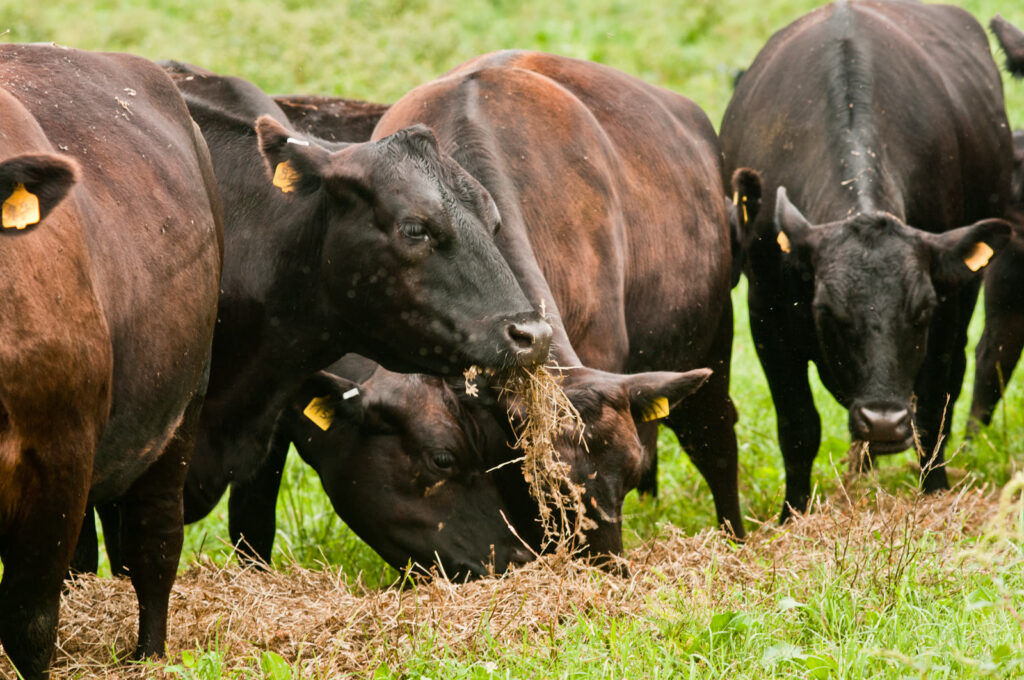
Weaned calves are calves that no longer rely on milk: they eat solid feed, drink water and have a working rumen. The trade uses several names for roughly the same animal, and those names shift from country to country. An Irish offer of weanlings, a French list of broutards and a US article on stocker calves can leave a buyer with three different pictures. Here is how the terms differ and how they map onto the weight classes we buy in.
What “weaned” means on a working farm
How and when weaning happens depends on the system the calf was born into.
On a dairy farm the calf leaves the cow early and is reared on milk or milk replacer, with calf starter and hay alongside. Once it eats enough, the milk is stopped. A weaned dairy calf is still a fairly light animal, and in trade it usually sits in the starter class rather than among weaned beef stock.
In a suckler herd the calf stays with its mother for months, grazing more as it grows. Weaning means separating calf and cow, often in autumn, and the animal that comes out of it is much heavier, with a frame built on grass and the cow’s milk. This is what most people mean by a weanling or weaned beef calf.
Both are weaned. They are not interchangeable, and an offer that says only “weaned” leaves the buyer guessing which one is in the shed.
Weaned calves, weanlings, stockers and stores compared
The vocabulary changes with the market. The table is a guide to usage, not a legal definition:
| Term | Where you hear it | What it usually describes |
|---|---|---|
| Weaned calf | General, all markets | Any calf off milk and on solid feed, dairy or beef |
| Weanling | Ireland, UK | A suckler-bred calf sold after weaning, typically in the autumn sales |
| Stocker calf | USA | A weaned calf grown on grass or forage before it goes to a finishing yard |
| Store | Ireland, UK | Growing cattle, often older than weanlings, bought to be finished later |
| Broutard | France | A weaned suckler calf sold for finishing, traditionally to Italy and Spain |
All of these share a beef purpose and a calf past the milk phase. What separates them is age, frame and what the next owner plans to do. The label matters less than the facts behind it: breed, sex, age range, weight range and how long the group has been off milk.
How we class weaned calves by weight
On our buying terms page we publish three indicative weight classes:
- Dairy calves: 52 to 90 kg
- Starter calves: 110 to 150 kg
- Weaned or stocker calves: 220 to 350 kg, beef breeds only
These ranges are a guide, not a fixed spec. Age, weight, breed mix and sex are agreed with the supplier for each lot before collection.
Two things follow. Our weaned class is a beef class: Limousin, Charolais, Angus, Hereford, Simmental and Belgian Blue, and crosses of them. A weaned Holstein bull calf in the 110 to 150 kg range is offered as a starter calf, even though it is off milk. And weight places a lot more reliably than the word on the offer sheet. A suckler calf weaned early and still under 220 kg is discussed as a lighter lot.
Stock of this kind comes mostly from beef suckler regions. France is the obvious case, and our page on buying calves in France covers the breeds, papers and certifying authority there. The Charolais breed guide explains how weaned stores differ from young Charolais-cross calves, the same distinction drawn here.
Why weaning status changes the journey
Weaned or unweaned is not only a feeding question. Under Council Regulation (EC) No 1/2005 it changes how long animals may travel before a rest.
On long journeys in vehicles that meet the regulation’s extra standards, unweaned calves still on a milk diet must rest for at least one hour after nine hours of travel, with liquid and feed if needed, and may then travel up to nine more hours. Other cattle, weaned calves included, rest after 14 hours and may then go up to 14 more. After that the animals must be unloaded, fed, watered and rested for at least 24 hours.
Source: Council Regulation (EC) No 1/2005, Annex I, Chapter V, points 1.4 and 1.5, text as published on EUR-Lex, as of 17 October 2026.
The farm side counts just as much. A calf taken off the cow the morning the truck arrives is not settled. It has not learned to eat from a trough or use a drinker, and it often travels badly. Buyers want calves that have been weaned for a while and are eating well. Wean, house and group them first, then offer them.
We buy EXW: the calves are collected at your farm or collection point, and we run the transport ourselves with our own trucks under Regulation 1/2005. The minimum lot is 28 head for TYPE 1 transport, up to eight hours’ drive, and 150 head for TYPE 2 long-distance transport with a trailer. Heavier calves need more floor space per head, so headcount and weight range shape the load plan.
Describing a weaned lot in your offer
A short, complete first message saves a week of questions. For weaned stock, include:
- breed and cross, with the sire breed if known
- number of head and the split between bulls, steers and heifers
- age range and the real weight spread, not just an average
- weaning date or weeks off milk, and the current diet
- ear-tag numbers, and whether passports are ready
- the week you could load
Every animal needs ear tags and a bovine passport. The EU INTRA health certificate is created in TRACES NT and issued by the official veterinarian before dispatch, and no loading takes place before it is issued. Payment terms and trial lot size are agreed with each supplier before the first loading; payment is in EUR.
If you are weighing up weaning against an earlier sale, our article on choosing the stage at which to sell sets the three stages side by side. For what Polish rearing farms check once a weaned group is on offer, see our notes on weanling lots for Polish farms.
Euro Cieleta buys for rearing and finishing farms in Poland from Ostrowo near Gostyń; read more about who we are and about regular supply partnerships. To offer a lot, use the supplier form, call or WhatsApp +48 691 900 728, or write to biuro@eurocieleta.pl.