The intra trade animal health certificate is the document that lets a lot of calves leave one EU country for another, and for a seller it is usually the step that decides whether the truck leaves on time. Most people in the trade call it the INTRA certificate or ITAHC. It is created in TRACES NT, the European Commission’s online system, and it has to be signed by the official veterinarian before the animals go anywhere. Below is how it works for a calf lot heading to Poland, who does which part, and where sellers lose a day without meaning to.
What the intra trade animal health certificate covers
When live cattle move between member states, the EU Animal Health Law, Regulation (EU) 2016/429, requires them to travel with an animal health certificate. The detailed conditions for bovine animals are in Delegated Regulation (EU) 2020/688, and the certificate models themselves are set in Commission implementing acts. The certificate is built in TRACES NT on the model for bovine animals, and the system sends the record to the authority in the country of destination.
The certificate confirms where the animals come from, that the holding of origin meets the health conditions for the movement, that each animal is identified and that the official vet has checked the consignment. It is not a general health report and it is not the same as a passport. The passport follows the individual animal for life. The certificate belongs to one consignment, on one date, to one destination.
Who issues it in each supplier country
The certificate is issued by the veterinary authority of the country the calves leave from. On our pages for the eleven supplier countries we list the authority for each one: VMVT in Lithuania, PVD in Latvia, the Agriculture and Food Board (PTA) in Estonia, ŠVPS in Slovakia, SVS in Czechia, the local Veterinäramt in Germany, Nébih in Hungary, DAFM in Ireland, the DDPP or DDETSPP in France, NVWA in the Netherlands and ANSVSA in Romania.
How the work is split also differs. In some countries the operator or a private vet prepares the consignment details in TRACES NT and the official vet checks and signs them. In others, the local office does most of it. Ask your own office early how they want the request, how much notice they need and whether they certify on the day of loading. Those three answers set your loading calendar.
TRACES NT steps for a calf consignment
The screens vary by country, but this order keeps a loading day predictable.
1. Agree the lot before you book the vet
The certificate lists the animals, so the lot has to be fixed first. That means the ear-tag numbers, breed, sex and age of every calf, and the number of head. Our minimum lot is 28 head for TYPE 1 transport, up to 8 hours’ drive, and 150 head for TYPE 2, long-distance transport with a trailer. Weight classes are indicative, and the spec for each load is agreed per lot.
2. Check identification and passports
Every animal must be individually identified with ear tags and have its bovine passport or identification document. A missing tag or a passport that does not match the tag is the most common reason a vet stops a calf from going on the certificate. Check this at the pen, not at the loading ramp.
3. Enter the consignment details
The consignment details go into TRACES NT: consignor and holding of origin, consignee and place of destination, the transporter and the means of transport, and the list of animals. As we collect with our own trucks, we give you the transporter’s authorisation and vehicle details in good time, so this part is not a guessing game.
4. Official vet check and signature
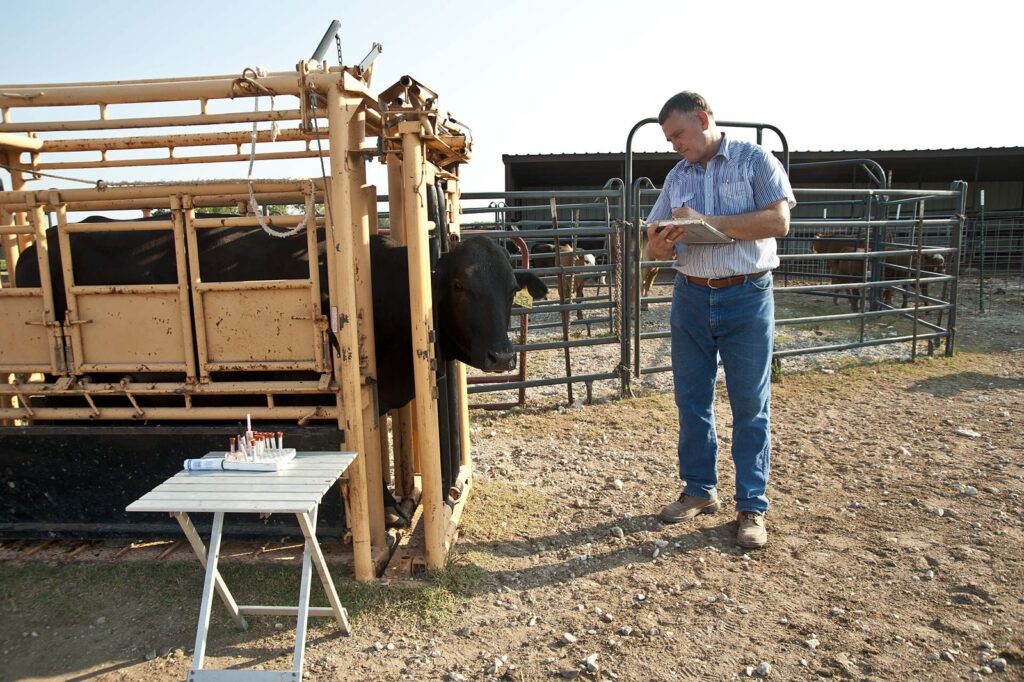
The official veterinarian checks the animals and the records against the health conditions in 2020/688 and signs the certificate in the system. Only then is it issued. On our side the rule is short: no loading before the certificate is issued.
5. Copy with the load
The driver carries the certificate with the consignment, together with the passports. The destination authority already sees the record in TRACES NT, and the animals arrive at the holding stated on it.
Where sellers lose time on the certificate
Most delays are not about health at all. They come from details that did not match. A calf swapped into the group after the list was sent, a passport left at the farm office, a destination address written two different ways, or a vet appointment booked for the afternoon when the truck was due at nine.
Disease rules are the other variable. Bluetongue, for example, changes which statements the vet can sign and what extra conditions apply. EU rules on bluetongue movements are changing from 1 November 2026, and we explain the routes the vet can use in our note on bluetongue rules for calf lots from November. If your region has a restriction, tell us before the lot is fixed, not on loading day.
The certificate is one part of a wider set of checks. For the wider list of what a buyer in Poland checks, see our overview of veterinary checks for calves going to Poland.
How we work with the certificate on our side
The terms are set out on our buying terms page: price basis EXW, prices and payments in EUR, price per head agreed per lot, and collection at your farm or collection point with our own trucks. Our transport runs under Council Regulation (EC) No 1/2005, with an authorised transporter, an approved vehicle, a driver with a certificate of competence and a journey log for long journeys.
Before the first load we agree the payment terms and the size of a trial lot. For the paperwork, the supplier checklist (PDF) lists what should be ready before the official vet arrives. Our registration details and purchasing contact are on the company page.
If you have a lot ready, send its age, weight and ear-tag numbers through the supplier offer form, or call +48 691 900 728 or write to biuro@eurocieleta.pl. Traders and exporters looking for repeat business can read how regular supply works on our page for supply partners.
Sources named in this article: Regulation (EU) 2016/429, Delegated Regulation (EU) 2020/688, Council Regulation (EC) No 1/2005 (EUR-Lex), and TRACES NT (European Commission). As of 22 October 2026. Rules can change; your official veterinarian has the final word on what can be certified.