
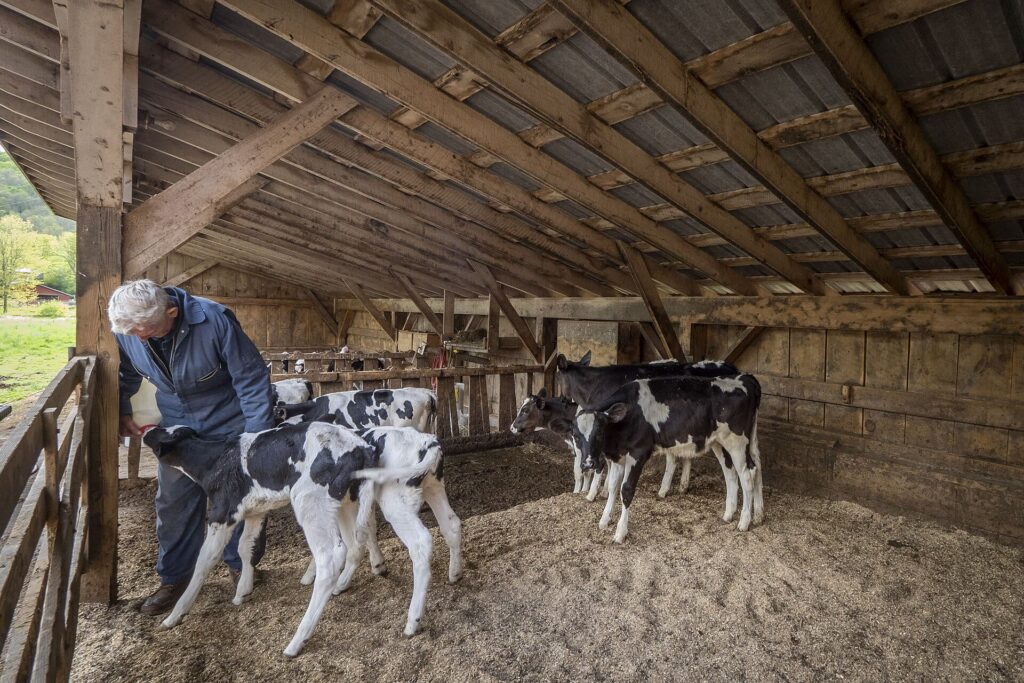
What do dairy farms do with male calves? On most herds the answer comes down to three routes: rear them at home, sell them young to a local rearer or dealer, or sell them in regular lots to a buyer further away who rears or finishes them. Which route makes sense depends on the farm’s space, labour and calving pattern far more than on any single market week.
A Holstein heifer calf has an obvious future in the milking herd. Her brother does not: he will never produce milk, and he takes up a pen, milk and time from day one. That is why a dairy farm needs a plan for bull calves before calving season, not after the hutches are full.
What dairy farms do with male calves: the three usual routes
1. Rear them on the farm
Some farms keep their bull calves and rear them as bull beef or steers, either to finish themselves or to sell later as weaned stock. It keeps the animals at home but ties up housing, feed and labour for months, often at the expense of the heifers that matter more for the herd.
2. Sell them young, close to home
The most common route is selling bull calves at a few weeks old to a local calf rearer, a dealer or through a mart. It frees space quickly, but demand moves with the season, a busy sale day can swamp the local outlet, and the farm has little say in when and to whom the calves go.
3. Sell lots to a rearer or fattener abroad
The third option is to group calves into regular lots and sell them to a buyer in another EU country who rears or finishes them. Poland is one of those destinations: Polish farms fatten bulls and need a steady intake of calves, as described in our piece on demand for calves on Polish fattening farms. For the dairy farm, the appeal is a planned outlet that does not depend on the local mart that week.
Many herds also use sexed semen on their best cows and beef semen on the rest, so fewer pure dairy bulls are born. The herd still needs a route for the ones that are.
Selling male dairy calves abroad: what changes for the farm
Selling across a border sounds like more paperwork. In practice it is mostly the records a farm already keeps, plus one certificate and some planning around collection days.
Here is how it works when you sell to us. We buy EXW, which means we collect the calves at your farm or collection point with our own trucks. You do not need to arrange transport. Prices and payments are in EUR, and the price per head is agreed per lot, because there is no published price list. Payment terms and the size of a trial lot are agreed with each supplier before the first loading. The full terms are on our page about how we buy calves.
Lot size depends on distance. For a journey of up to about 8 hours’ drive (TYPE 1) the minimum lot is 28 head. For long-distance transport by trailer (TYPE 2) the minimum is 150 head. A farm with few bulls a month can pool calves with a neighbour or a collection point to reach the minimum.
For weights, the dairy calf class we buy is roughly 52 to 90 kg. Treat that as an indicative range only: the exact age and weight spec is agreed for each lot. Holstein Friesian bull calves are the main dairy type we take; our Holstein Friesian breed page sets out what we look for in a lot.
Papers and preparation before the truck arrives
Every calf needs to be individually identified with ear tags and have its bovine passport or identification document. Before loading, the official veterinarian in your country issues the EU INTRA animal health certificate in TRACES NT. The rule on our side is simple: no loading before the certificate is issued.
Transport rules sit with us as the transporter. Under Council Regulation (EC) No 1/2005 that means an authorised transporter, an approved vehicle, a driver with a certificate of competence and a journey log on long journeys. The same regulation sets fitness-for-transport rules, including limits for very young calves, so calf age has to fit the planned route. Source: Council Regulation (EC) No 1/2005 and Delegated Regulation (EU) 2020/688, published on EUR-Lex, as of 31 October 2026.
On the farm, the preparation that makes a collection day go smoothly is mostly practical:
- keep calves of a similar age and weight together, so the lot is even;
- check that tag numbers match the passports before the vet visit, not on the day;
- tell the buyer early how many calves you expect per month, so collections can be planned;
- agree a loading point with good truck access.
Our post on how Holstein bull calves are traded goes further into what a buyer checks when the calves are inspected.
Which route fits your farm
A farm with spare buildings and cheap feed may do well rearing its own bulls. One near a strong local calf trade may be happy selling young. A farm with a steady flow of bull calves through the year is usually the best fit for regular lots to a buyer abroad.
Repeat supply is what makes that third route work. A buyer can plan trucks and placements around a supplier who sends a similar lot every month; a one-off load of mixed ages is harder to place. That is why we start with a trial lot and build towards regular collections.
We work with farms, traders and exporters in eleven countries, from the Baltic states to Ireland and France; the list is on our supplier countries page. If you want to know more about the company before you talk numbers, read who we are and where we are based, near Gostyń in western Poland.
Offering your bull calves
If you have male calves to place regularly, tell us what you have. Use the supplier form on our contact page and fill in the country, breed, sex, how many calves you can supply per month, typical age and weight, and which documents are ready. Send ear-tag numbers with a concrete offer. You can also call or message us on WhatsApp at +48 691 900 728, or write to biuro@eurocieleta.pl. We answer in English, Polish or Russian.
If you would rather see the overall terms of a long-term supply partnership first, they are on the partners page.