
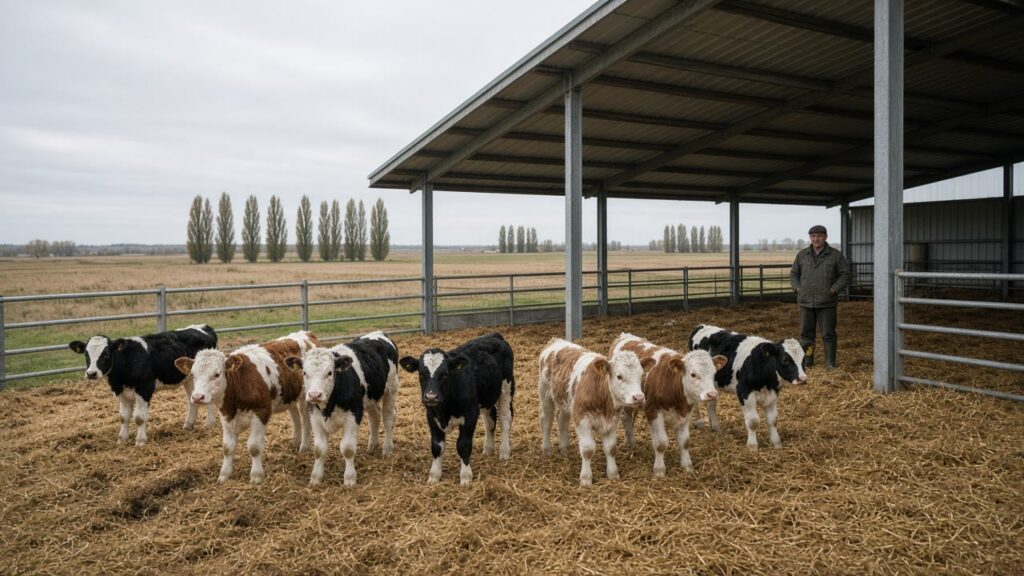
Cattle farming in Poland rests on two legs that do not always move in step: dairy herds that produce calves as a by-product of milk, and rearing and fattening farms that need a steady flow of young stock to fill their barns. When the second leg grows faster than the first, Polish farms look abroad. Here is how the sector is built, where the gap comes from, and what it means for a foreign calf seller.
We write from the buyer’s side: our company is based in Ostrowo near Gostyń, in western Poland, and buys calves abroad for Polish farm demand.
What cattle farming in Poland looks like in 2026
According to Statistics Poland (GUS), the national cattle herd stood at 6,229.1 thousand head in June 2026, 1.3% more than a year earlier and 1.4% more than in December 2025. GUS attributes the year-on-year increase to more calves under one year of age. The data are based on records from the Agency for Restructuring and Modernisation of Agriculture (ARiMR), counted by the seat of each herd.
Source: Statistics Poland (GUS), “Cattle stock as of June 2026”, released 15 September 2026. Figures as of 14 November 2026.
Behind the national total sits a very mixed farm structure. Large specialised dairy units work next to family farms with a few dozen cows, and next to farms that keep no cows at all and only rear or finish cattle bought in. That last group matters most to a calf seller: a finishing farm buys its animals in, grows them on a planned ration and sells them for slaughter, so its buying never really stops.
Most calves born in Poland come from dairy herds, and black-and-white Holstein Friesian cattle dominate those herds. Dairy farms keep the heifers they need for replacement and sell the rest, together with most of the bull calves. The supply exists, but it is fragmented, seasonal and tied to the calving pattern of milk producers rather than to the needs of the farms that buy.
Where the domestic supply falls short
A fattening farm plans in batches. It wants a group of calves of similar age, weight and type arriving together, so that the whole pen moves through the same feeding stages and leaves at the same time. Domestic supply often does not come in that shape. A typical dairy farm sells a few calves a week, of mixed breeds and ages. Gathering a uniform group of 60 or 150 animals locally takes time and a lot of sorting.
There is also the question of type. Farms finishing beef cattle prefer beef breeds or beef-on-dairy crosses. Pure dairy bull calves suit a different feeding programme. The local market cannot always provide a given type and weight class in the required number, in the required week.
So demand for imported calves is less about the size of the Polish herd than about the fit between what dairy farms sell and what fattening farms want. We wrote about that demand side in more detail in our piece on what Polish fattening yards ask for.
Why Polish farms buy calves abroad
Buying across the border solves the batch problem. A large dairy farm, a calf collection centre or an established exporter in another member state can often offer a group of calves of one type in one loading. One well-documented lot replaces several local purchases, and the animals start rearing on equal terms.
Intra-EU trade makes this workable. Calves moving between member states travel with ear tags and a passport for each animal, an animal health certificate issued in TRACES NT before loading, and transport under Council Regulation (EC) No 1/2005. The rules are the same in every source country, so the paperwork is predictable. If you are new to selling across a border, our overview of how calf trade between EU countries works walks through the steps.
Regular supply is the other reason. A rearer who finds a reliable source abroad wants the same type again, month after month, which is why we prefer long-term cooperation and repeat lots over one-off deals. A trial lot is a normal way to start, and the details of what we buy and how are set out on our buying terms page.
What this means if you sell calves to Poland
The Polish market rewards clarity more than volume claims. An offer should include:
- breed or cross, and sex;
- age and weight of the animals;
- number of head available, and how often;
- ear-tag numbers and the state of the documents;
- the farm or collection point where the calves can be loaded.
We work with three main groups: dairy calves of roughly 52–90 kg, starter calves of around 110–150 kg, and weaned beef-breed calves of 220–350 kg. These ranges are indicative only. The exact spec is agreed for each lot.
On commercial terms, we buy EXW: we collect the calves at your farm or collection point with our own trucks, so you do not have to organise transport. Prices and payments are in EUR. There is no price list; the price per head is agreed for each lot, and payment terms are settled with each supplier before the first loading. The minimum lot is 28 head for journeys of up to 8 hours’ drive (TYPE 1) and 150 head for long-distance transport by trailer (TYPE 2).
How the first lot moves from your farm to a Polish barn
You send an offer with the details above. We confirm the type and the spec, agree the price per head and the payment terms, and fix a loading date. Your official veterinarian issues the health certificate in TRACES NT before the calves are loaded. Our truck arrives at the agreed point and the animals are checked against the papers.
We buy from 11 countries, each with its own page in our supplier countries overview. If you want to know more about the company before you send an offer, the about page lists our registration details and the person responsible for purchasing.
If your farm or trading business can supply calves on a regular basis, the most direct route is the supplier enquiry form, or you can read what we expect from long-term calf supply partners first. You can also call or message us on WhatsApp at +48 691 900 728, or write to biuro@eurocieleta.pl. We answer in Polish, English and Russian.