
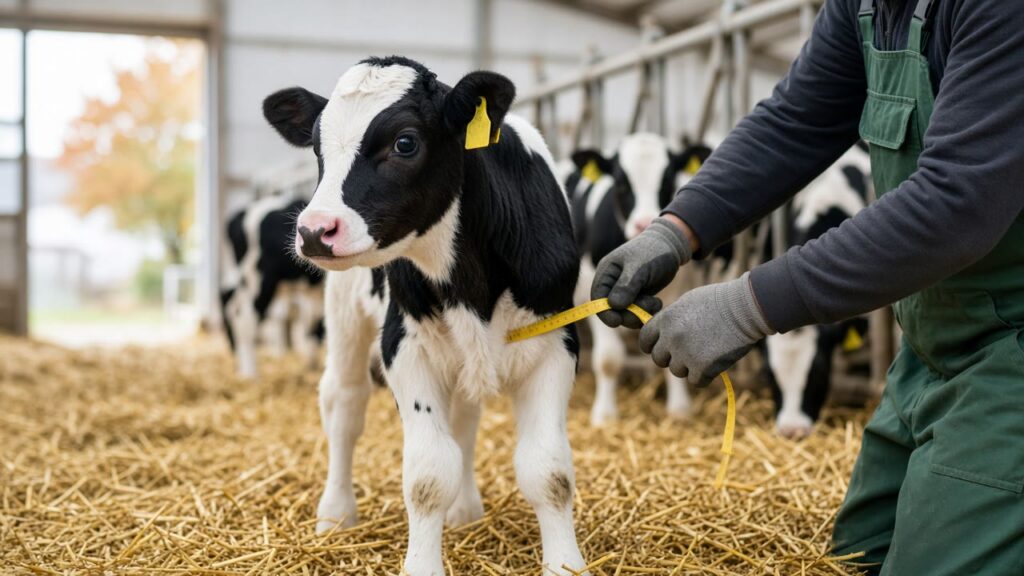
Calf weight by age is the first thing a buyer checks in an offer, and usually the line sellers fill in last. “Holstein bulls, 3–5 weeks” leaves the buyer guessing. “Holstein bulls, 21–35 days, 58–70 kg, ear-tag list attached” can be priced the same afternoon. Below are published growth targets in kilograms, how they map onto the weight classes calves are traded in, and how to state both so the numbers hold up at loading.
Calf weight by age: a kg chart from birth to six months
There is no single official chart, because breed, sex and feeding all move the curve. The most useful public references come from UK and Irish advisory bodies: AHDB sets dairy heifer targets as a share of mature weight (its example assumes a 685 kg cow), and Teagasc gives minimum targets for dairy-bred calves and 200-day targets for suckler calves. The figures below are quoted from those sources.
| Age | Weight (kg) | Type of calf | Source |
|---|---|---|---|
| Birth | 41 | Dairy heifer | AHDB |
| 1 week | 48 / 45 | Holstein / Angus or Hereford cross | Teagasc (minimum target) |
| 1 month | 55 | Dairy heifer | AHDB |
| 6 weeks | 73 / 70 | Holstein / Angus or Hereford cross | Teagasc (minimum target) |
| 8 weeks | about 80 (birth weight doubled) | Dairy-bred calf | Teagasc |
| 12 weeks | 102 / 100 | Holstein / Angus or Hereford cross | Teagasc (minimum target) |
| 3 months | 116 | Dairy heifer, post-weaning | AHDB |
| 15 weeks | 119 / 117 | Holstein / Angus or Hereford cross | Teagasc (minimum target) |
| 6 months | 185 | Dairy heifer | AHDB |
| 200 days | 300 / 250 | Suckler bull / suckler heifer | Teagasc (target) |
Teagasc’s target for dairy-bred calves is 700–800 g a day, which is where the rule of thumb “double birth weight by eight weeks” comes from (40 kg to 80 kg in 56 days). Suckler calves running with the cow grow faster, at a target of 1.2–1.3 kg a day to weaning, so by six to seven months the gap between a dairy heifer and a suckler bull is more than 100 kg.
How the chart lines up with the weight classes buyers trade
Buyers rarely talk in weeks; they talk in weight classes, and those follow the chart closely. The ranges we publish on our trade terms page are indicative; the exact spec is always agreed per lot.
Dairy calves, 52–90 kg
On the targets above, a Holstein-type calf passes 52 kg in its second or third week and reaches 90 kg somewhere between eight and twelve weeks. This is the class for young Holstein Friesian bull calves going to rearers and for heifers sold as herd replacements (see our post on sourcing replacement heifers). Beef-sired calves out of dairy cows often sit here too; the beef-dairy cross page explains how buyers read those lots.
Starter calves, 110–150 kg
A dairy-bred calf reaches 110–120 kg around twelve to fifteen weeks on Teagasc’s minimum targets, and 150 kg roughly between three and five months. By then it is weaned, eating concentrate and forage, and far less fragile on a truck.
Weaned or stocker calves, 220–350 kg (beef breeds only)
This class belongs to suckler-bred beef calves. Teagasc’s 200-day targets of 250 kg for heifers and 300 kg for bulls fall right inside it, and its beef system guidelines assume weaning weights of 320 kg for males and 290 kg for females. A dairy heifer at 185 kg and six months does not come close, hence the beef-only rule. If you sell weanlings in the autumn, the post on weanlings for Polish farms covers that trade.
Why the same age can mean very different weights
Most of the spread inside a lot comes from breed and sire, sex, birth weight, how much milk the calf got in its first weeks, and setbacks such as scour or pneumonia. AHDB recommends weighing at birth, at weaning and at six months, because daily gain needs two real measurements. A tape beats a guess; a scale beats a tape.
Buyers care for a practical reason. Teagasc notes that “weight for age” (liveweight divided by age in days) is positively linked to lifetime daily gain and carcass weight, and that lighter calves carry a higher risk of dying in their first three weeks on a new farm. A calf that is light for its age is a risk the next owner prices in.
Age also sets a hard floor on moving calves. Under Council Regulation (EC) No 1/2005, Annex I, Chapter I, calves younger than ten days are not fit for transport unless the journey is under 100 km, and no newborn may travel before its navel has fully healed. In practice, a calf sold abroad is older than ten days at loading, whatever it weighs.
Stating weight and age in an offer
A clear offer saves a round of phone calls:
- Age as a range in days, taken from the dates of birth in the passports, not from memory.
- Weight as a range in kg for the whole group, and say whether it was weighed or estimated.
- Breed or cross, sex, number of head and how many you can supply per month.
- The ear-tag numbers, so the buyer can check age and origin against the passports.
Group by weight before you offer. A lot of 40 calves spanning 50 to 110 kg falls across two classes and will be valued at the weaker end. Two tidier groups usually work better, as long as each meets the minimum lot: 28 head for TYPE 1 transport (up to 8 hours’ drive) or 150 head for TYPE 2 long-distance transport by trailer. We buy EXW and collect with our own trucks, so the weights that count are the ones at your farm or collection point on loading day. Price per head is agreed per lot in EUR.
The supplier offer form has a field for weight and age, and the FAQ lists what else to include. To see what Euro Cieleta looks for in a long-term supplier, start with the partner overview. Phone and WhatsApp: +48 691 900 728, email biuro@eurocieleta.pl.
Sources
As of 12 October 2026. Growth figures are advisory targets, not guarantees, and are quoted as published:
- AHDB, Monitoring dairy calf growth (Table 1, target weights for dairy heifers by age).
- Teagasc, Calf Rearing Manual (minimum target weights for Holstein and early-maturing crossbred calves; doubling birth weight by 56 days).
- Teagasc, Improving suckler returns through better 200-day calf weights, and Beef Production System Guidelines.
- Council Regulation (EC) No 1/2005, consolidated text on EUR-Lex, Annex I, Chapter I (fitness for transport).