
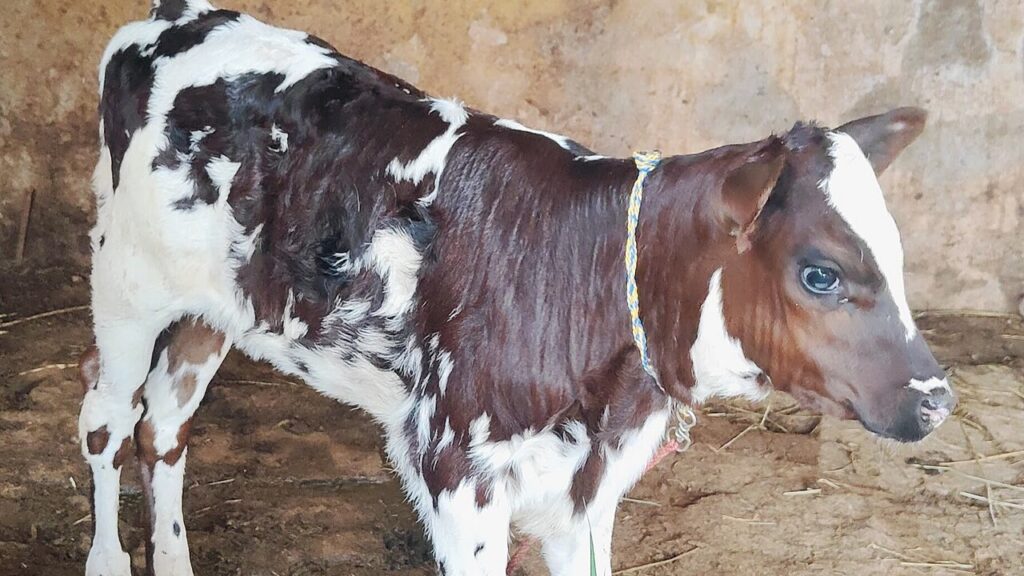
Dairy bull calves leave the milking herd every week, and the question for most farms is not whether they will sell them, but to whom and on what terms. Holstein and Friesian bull calves are the main dairy-bred stock that rearers and fatteners take on; heifers stay for replacement, bulls move into the fattening channel. This page sets out where those calves sell, what buyers check before they price a lot, and how to present an offer that can be answered the same day.
The breed background sits on our Holstein Friesian breed page — the main dairy breed; heifers for replacement, bull calves for fattening. What follows is the trade side: weight class, papers, lot size and repeat supply, not a breed profile.
Dairy bull calves: the fattening outlet, not the herd
A dairy farm keeps heifers for its own herd or sells them as replacements. Bull calves from the same cows are a different product. They are sold as calves for fattening — young stock that a rearer or finisher will grow on, not animals that return to milk. That split is why offers need to say sex clearly: “dairy bull calves” or “Holstein bulls for fattening” tells the buyer which channel you mean.
Polish farms buy those calves for rearing and finishing. Demand for that channel is covered in our note on fattening calves and Polish farm demand. The buyer is looking for healthy, uniform lots with complete ID and a certificate ready before loading, not for a one-off odd lot without papers.
Breed type still matters. Holstein and Friesian genetics dominate dairy bull lots across much of Europe. Dairy crosses and beef-sired calves out of dairy cows show up in the same weight band, but a mixed lot needs the mix stated up front. Uniformity of type and weight makes a lot easier to place than a wide spread of ages and sizes.
What buyers check: weight, age, ID and the certificate
The first line buyers read is the weight class. For young dairy stock, the indicative range we publish is 52–90 kg. That is not a fixed gate; the specification is agreed per lot. Age in days, taken from the passports, should sit next to the weight range so the buyer can see whether the calves are light or heavy for their age. A separate note on calf weight by age in kg shows how those ranges map onto growth targets.
Documents come next. Every animal needs individual identification (ear tags) and a bovine passport or identification document. For movement between EU Member States, the official veterinarian issues an EU INTRA animal health certificate in TRACES NT before dispatch, under Delegated Regulation (EU) 2020/688. No loading before that certificate is issued. Transport then runs under Council Regulation (EC) No 1/2005: authorised transporter, approved vehicle, certified driver, and a journey log on long journeys.
A practical buyer checklist for dairy bull calves looks like this:
- Sex and breed type stated (e.g. Holstein / Friesian bulls, or dairy crosses)
- Weight range in kg and age range in days, with the note that the final spec is agreed per lot
- Ear-tag numbers listed or attached to the offer
- Confirmation that passports are ready and that the vet can open the INTRA certificate in TRACES NT on the planned loading date
- How many head you can supply per month, and whether you want a trial lot or regular loadings
Price is agreed per head per lot in EUR. There is no published price list. The basis is EXW: the buyer collects at your farm or collection point. We organise collection with our own trucks; we do not ask the supplier to haul the lot into Poland. Payment terms and any trial-lot size are fixed with you before the first loading. Full trade terms are on how we buy calves.
Lot sizes that fit the truck: 28 and 150 head
Minimum lot size follows journey type. TYPE 1 — transport of up to eight hours’ drive — starts at 28 head. TYPE 2 — long-distance trailer transport — starts at 150 head. Those floors exist so a truck leaves full and the journey stays within the rules that apply to live transport. Smaller groups can be discussed as a trial, but the published minima are what regular lots are built around.
Grouping matters as much as the total. A lot of dairy bull calves that sits in a tight weight band (for example 55–75 kg) travels and places better than the same headcount spread from 50 to 95 kg. Send the ear-tag list with the offer so the buyer can see the spread before the truck is booked.
Repeat supply is preferred over one-offs. Farms and traders who can plan monthly or fortnightly loadings of similar dairy bull calves build a working rhythm: same weight class, same papers routine, same collection point. Trial shipments are welcome; the aim is ongoing cooperation once the first lot has cleared without problems. How that partnership side works is described on our partners page.
How to offer dairy bull calves without a round of clarification calls
Most delays come from incomplete offers. “Holstein bulls available” is not enough to price. A usable offer names the country, the farm or trader, contact details, breed and sex, calves per month, weight and age ranges, whether documents are ready, and any notes the vet has already raised about the certificate. Languages we work in are English, Polish and Russian.
Common gaps that slow a reply:
- No ear-tag list or passport status
- Weight given without age, or age without weight
- Heifers and bulls mixed without saying so
- Loading week proposed before the vet has confirmed the certificate can be issued
- Asking the buyer to arrange supplier-side haulage when the term on offer is EXW collection by the buyer’s trucks
Answers to the usual supplier questions — lot size, documents, languages, who we buy from — sit in the FAQ. For a broader list of what foreign buyers ask before they commit, see what buyers need when you sell calves to Poland.
When the lot is ready to discuss, use the supplier form on the contact page (section “I want to supply calves”), call +48 691 900 728, or write to biuro@eurocieleta.pl. Include country, capacity, breed types, typical documentation and the weight class you usually ship. Euro Cieleta buys for Polish farm demand on an EXW basis and collects with its own trucks once the certificate is in place.