
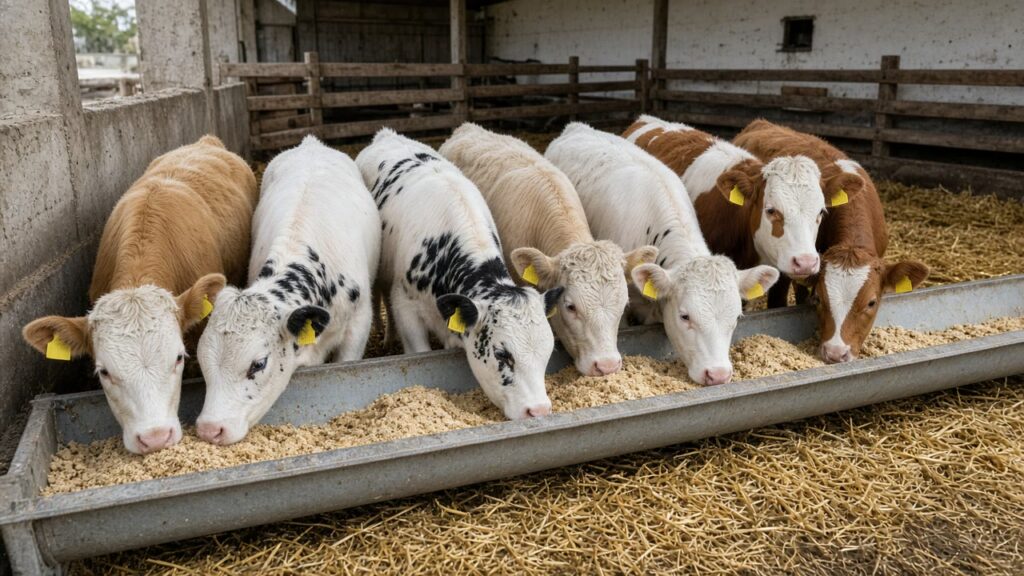
Starter calves are the middle class of the calf trade: no longer the fragile young calf that left its dam a few weeks ago, not yet the heavy weaned animal that goes straight onto a finishing yard. The term causes more confusion than it should, mostly because the same two words are also printed on bags of feed.
Below: what the term means when calves change hands, where the weight line sits, and when it pays to sell at this stage.
Starter calves in trade, not on the feed bag
Much of what comes up under the phrase is about calf starter, the concentrate fed alongside milk to get the rumen working. That is feed. In trade, a starter calf is an animal. It has been reared through the milk phase, it eats solid feed, and it is ready to move onto another farm’s rearing or fattening system.
On our side, starter calves are one of three weight classes we buy in:
- Dairy calves: 52 to 90 kg, young animals, mostly dairy and dairy-cross.
- Starter calves: 110 to 150 kg.
- Weaned or stocker calves: 220 to 350 kg, beef breeds only.
These ranges are indicative. The actual specification, including weight window, breed mix and sex, is agreed per lot. More on the classes and how we collect is on the How we buy page.
What a buyer checks in a starter lot
A starter calf has already had weeks of milk, feed and labour. The buyer checks whether the rearing shows.
Evenness. A lot of starter calves that runs from 105 to 155 kg is harder to place than one that sits within a narrower window. Fattening farms want to put the group in one pen and feed it as one group. Uneven lots get split.
Condition on solid feed. Calves that eat well, drink well and have not been set back by scours or respiratory problems in the milk phase settle faster after transport. A starter calf that is still struggling with the change from milk is, for the buyer, a young calf in a bigger body.
Breed and type. At this weight the difference between a dairy bull and a beef cross is easy to see, and it matters for what the next farm does with the animal. For beef crosses out of dairy herds, see what we look for on the Belgian Blue breed page. Dual-purpose Simmental calves are another common type in starter lots.
Papers. Every animal individually identified with ear tags and a bovine passport or identification document. Before loading, the official veterinarian certifies the EU INTRA animal health certificate in TRACES NT. No loading before the certificate is issued.
When selling at starter weight makes sense
There is no single right answer to when a calf should leave the farm. It depends on feed, labour, housing and how many calves come through each month. A longer look at timing is in our post on choosing the moment to sell calves. For the starter stage specifically, a few situations come up again and again.
You have rearing capacity, but not finishing capacity. Many dairy farms and rearing units handle the milk phase well but have no room to keep calves for months more. Selling at starter weight passes the animal on before it competes with the next batch for space.
You want to sell a better-defined animal. By 110 to 150 kg the buyer can see type, frame and health. For good rearers, the work done in the first months is on display.
You are building a regular outlet. A trader or rearing unit that can deliver starters month after month, in similar weights and similar breed mix, becomes useful to a buyer quickly. Repeat lots are what we prefer to work with, rather than one-off loads.
Selling later, as weaned calves, can make sense for beef breeds and suckler herds. Selling earlier, at dairy-calf weight, suits farms that want the calf gone as soon as it can travel. The starter class fills the gap between them. If you want to see how weight usually develops week by week, the post on weight charts from birth to weaning gives the ranges used in the trade.
How to describe a starter lot in an offer
A short, accurate offer gets a faster answer than a long, vague one. For starter calves, the useful details are:
- number of head available now, and how many per month after that;
- breed or cross, and sex (bulls, heifers or mixed);
- actual weight range of the group and approximate age;
- ear-tag numbers, and whether passports are ready;
- where the calves stand: farm or collection point, with country and region.
Price per head is agreed per lot, in EUR, on an EXW basis. We do not work from a price list. Payment terms and the size of a trial lot are agreed with each supplier before the first loading.
The quickest route is the supplier offer form, which asks exactly for these fields. If you prefer to talk first, call or WhatsApp +48 691 900 728, or write to biuro@eurocieleta.pl.
Collection, lot size and transport
We collect starter calves at your farm or collection point with our own trucks. The seller does not need to organise transport. Transport runs under Council Regulation (EC) No 1/2005: authorised transporter, approved vehicle, certificate of competence for the driver, and a journey log for long journeys.
Minimum lots depend on distance:
- TYPE 1, up to 8 hours’ drive: minimum 28 head.
- TYPE 2, long-distance transport with a trailer: minimum 150 head.
We buy calves in eleven countries for the Polish market, from Lithuania and Latvia to Ireland, France and the Netherlands. Each country has its own page with the certifying authority and the typical papers; the overview is on the supplier countries page.
Common questions about documents, languages and how a first lot is arranged are answered in the supplier FAQ. If you rear or trade starter calves and want a regular buyer for them in Poland, the partnership overview explains how cooperation with Euro Cieleta usually starts.