
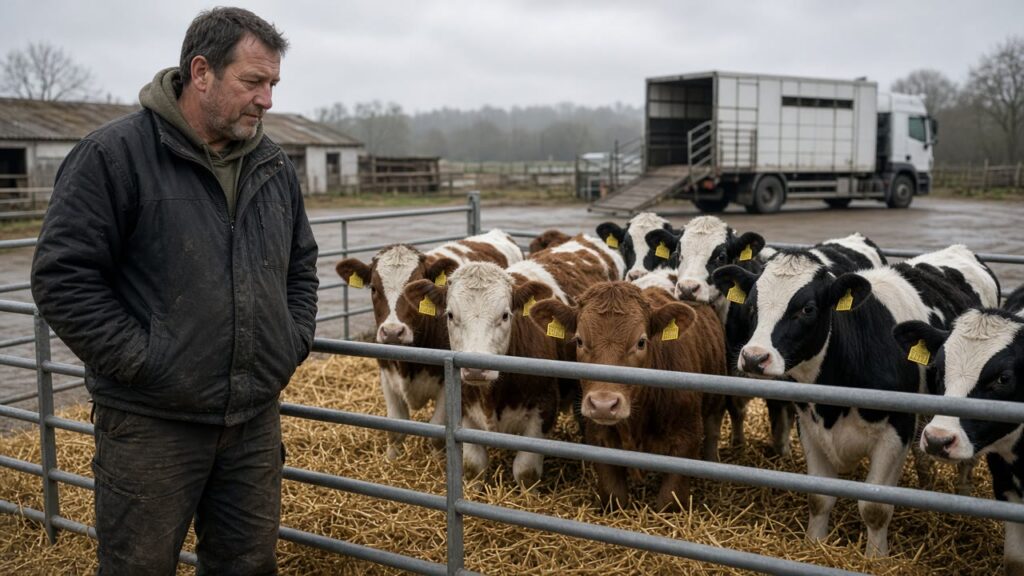
Selling calves directly to a buyer, rather than through the local mart, changes who sets the terms, when they are set and how much of the sale you can plan. For a farm or trader with regular numbers, that difference matters more than the price on any single day. This piece compares the two routes from the seller’s side and explains what a direct sale to a foreign buyer looks like in practice.
How the mart and a direct sale differ
At a mart, the price is found on the day. You bring the calves, the auctioneer runs the ring and the bidders decide. That is transparent and suits small or irregular numbers, but you carry the uncertainty: how many buyers turn up and what else is in the catalogue both show in the result.
In a direct sale, the terms are talked through before any animal leaves the farm. The buyer looks at what you describe, you agree a price per head for that lot, and you know where the calves are going and when they will be collected. You give up the chance of a lucky day in the ring and gain a buyer who wants the same type of calf again next month.
Handling differs too. A mart means loading, a journey, time in pens and the mart’s fees. A direct buyer working ex works collects from your yard, so the calves are loaded once, at home.
Selling calves directly to a foreign buyer: the terms
When the buyer is abroad, the terms need to be clearer still, because nobody is standing at the ringside to settle a question on the spot. Our own terms are set out on how we buy calves, and they cover the points most sellers ask about first:
- Price basis: EXW. We collect at your farm or collection point, with our own trucks. You do not need to arrange or pay for transport. If the delivery terms are new to you, our note on EXW delivery terms in livestock trade covers where loading and responsibility sit.
- Price: there is no published price list. The price per head is agreed for each lot, and prices and payments are in EUR.
- Payment terms and trial lot: agreed individually with each supplier before the first loading, so both sides know the arrangement before the truck is booked.
- Minimum lot: 28 head for TYPE 1 transport (up to 8 hours’ drive) and 150 head for TYPE 2, long-distance transport with a trailer.
The minimum lot is the point that most often decides whether direct selling works for a farm. A dairy unit with a steady flow of bull calves may build a TYPE 1 lot within a few weeks. A smaller herd may not, and that is where traders and collection points come in: several farms can pool calves at one site so the lot reaches the minimum and is collected in one go.
Which calves suit a direct buyer
We buy three broad types: dairy replacement heifers, bull calves for fattening and weaned calves. The weight ranges we publish are indicative: dairy calves around 52–90 kg, starter calves around 110–150 kg and weaned or stocker calves around 220–350 kg (beef breeds only). The exact spec for each lot is agreed with the seller, so a lot outside those bands is not automatically ruled out.
On the dairy side that means Holstein Friesian heifers for replacement and bull calves for fattening, plus beef-dairy cross calves. On the beef side, Limousin, Charolais, Angus, Hereford, Simmental and Belgian Blue are all on our list. Mixed lots are fine if described accurately.
We buy in eleven countries, each with its own page under supplier countries, with the papers typical for that country and the authority whose official vet issues the certificate.
Paperwork when calves leave the farm directly
A mart takes care of some of the administration for you. Selling direct, and across a border, the documents become part of the deal, and they need to be in order before loading day:
- every calf individually identified with ear tags and a bovine passport or identification document;
- an EU INTRA animal health certificate created in TRACES NT and certified by the official veterinarian before dispatch, under Delegated Regulation (EU) 2020/688;
- transport under Council Regulation (EC) No 1/2005, which is handled on our side: authorised transporter, approved vehicle, a driver with a certificate of competence and a journey log for long journeys.
One rule is fixed: no loading before the certificate is issued. If the vet appointment slips, the collection moves with it. Book the vet date first and the truck second.
What to send before the first collection
A direct sale starts with a usable offer. With the first message, send:
- the country and location of the calves (farm or collection point);
- the number of head, breed or cross, and sex (heifers, bulls or mixed);
- age and weight, plus the ear-tag numbers;
- how many calves you can supply per month if you expect repeat lots;
- which documents are ready and when the official vet can certify.
The quickest route is the supplier offer form on our contact page, which asks for exactly these details. You can also call or message on WhatsApp at +48 691 900 728, or email biuro@eurocieleta.pl. We work in English, Polish and Russian.
When the mart is still the better choice
It would be misleading to say direct selling always wins. If you sell a handful of calves a few times a year, the mart is simpler and the minimum lot will be hard to reach on your own. The same goes for calves that do not fit a clear spec, or that a direct buyer would turn down for health reasons: a calf that is not fit to travel should stay at home whichever route you choose.
Direct selling makes most sense when three things line up: regular numbers, calves that can be described and identified in advance, and a seller who values a planned collection more than the chance of a good day in the ring. If that sounds like your operation, the page for farms and traders who want to supply explains how a first trial lot is set up. For a wider view, see our piece on who buys calves across borders. Background on the company and the people you will deal with is on the about us page.