
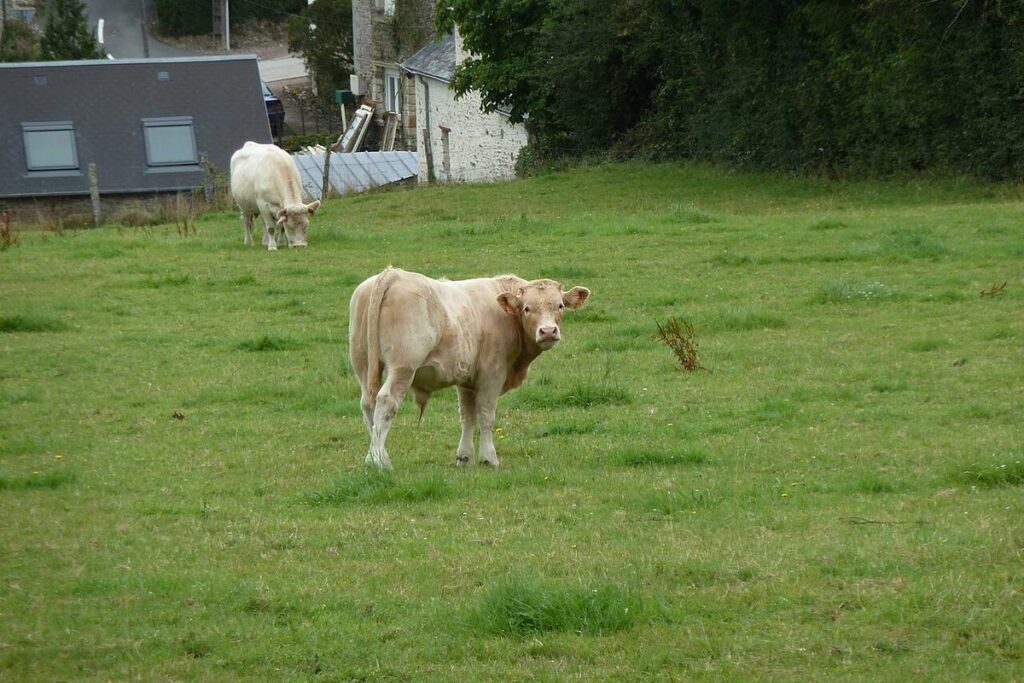
Charolais calves are one of the most requested beef types on Polish rearing and finishing farms, and one of the easiest to describe badly. A white calf with a heavy hindquarter can be a registered French purebred, a Charolais-sired dairy cross, or a mixed lot that only looks the part in a photo. This page is a sourcing brief for farms and traders who want to place Charolais and Charolais-cross calves in Poland: where supply comes from, which weights and ages work, what buyers check at the ramp, and how to keep a long haul from ruining a good group.
Where Charolais supply for Poland comes from
The breed comes from the Charolles and Nièvre area of Burgundy in central France, and France still holds by far the largest Charolais suckler herd in Europe. Most commercial supply reaching Polish farms falls into three streams:
- French weaned store cattle (broutards) — suckler-bred Charolais and Charolais-cross weanlings, usually 6–10 months and roughly 250–400 kg, traditionally sold for finishing in Italy and Spain and now also moving east
- Young Charolais-sired dairy crosses — Charolais bulls used on Holstein, Montbéliarde, or Fleckvieh cows give cream or light-grey calves sold at two to five weeks, typically 50–80 kg
- Central European herds — German, Czech, and Austrian suckler and dairy farms using Charolais sires, with shorter road times to western and southern Poland
Each stream suits a different Polish buyer. A finishing unit with no milk-feeding setup wants weaned stores. A rearing farm with calf hutches and a replacer programme can take young crosses. Say which stream your lot belongs to in the first line of the offer. Mixing the two in one truck almost always ends in a price argument. If you already ship from France, our notes on preparing offers from French holdings cover lot sheets and collection windows in more detail.
Weights, ages, and conformation buyers check
Charolais genetics sell on frame and growth. Polish buyers pay for that, but only when the lot shows it. At the ramp, and often before the truck is booked, they look at:
- Weight band — state the real spread. A group of 55–65 kg crosses feeds as one pen; 45–90 kg does not. For stores, keep the spread within about 40 kg
- Age and weaning status — young crosses should be eating and drinking well before loading; stores should be fully weaned, not pulled off the cow the morning of collection
- Muscling and legs — width over the loin, a deep hindquarter, and sound feet. Heavy muscling on weak legs is a finishing problem, not a bonus
- Cross declaration — Charolais × Holstein, Charolais × Montbéliarde, and purebred Charolais are priced and reared differently. Label each animal honestly
- Sex split — bull calves, steers, and heifers go to different programmes on many Polish farms
Birth weight matters in this breed. Purebred Charolais calves are often born heavy, and difficult calvings can leave calves slow to suck and weak in the first weeks. Buyers of very young animals will ask how calves were born and whether they got colostrum on time. You don’t need a vet report for every head, but you should be able to answer the question without guessing.
Coat colour alone proves little. Cream calves can come from other white or light breeds and crosses, so passport breed codes and sire information carry more weight than a photo. If the sire is a known AI bull, say so. Polish finishing farms that sell on carcass weight value documented beef sires.
Health status, documents, and the road from France
Charolais calves moving to Poland follow the same EU rules as any bovine consignment: registered holding, official ear tags, cattle passports, and a health certificate issued in TRACES by an official veterinarian before departure. Tags, passports, and the certificate must match the animals on the truck. If one calf is pulled after certification, tell the buyer before arrival so the numbers still agree at unloading.
Disease zoning has mattered more in recent seasons. Bluetongue and epizootic haemorrhagic disease restrictions have affected parts of France and neighbouring countries, and movement conditions can depend on the commune, vaccination status, and the date of loading. Check with your veterinarian what applies to your holding for the planned week. It is far better to flag a restriction early than to find it at certification. IBR and BVD status are also common questions from Polish farms, so have test or vaccination history ready. This is commercial guidance, not legal advice. The competent authority has the final word.
Distance is the real test for French Charolais. A load from Saône-et-Loire or the Allier to central Poland is a long journey under Regulation (EC) No 1/2005. That means planned rest, watering, and stocking density, plus calves that are fit at loading rather than just fit on paper. Young crosses need enough age and a healed navel to handle the trip. Stores travel better but still suffer if they are mixed from several farms the night before. Agree who books the transporter, who pays certification and loading, and what arrival window the Polish farm should staff for.
How Charolais calves fit Polish rearing systems
On Polish farms, Charolais-cross calves usually go into intensive bull beef systems on maize silage and concentrate, aiming for heavy, well-conformed carcasses. Weaned stores go straight onto finishing rations. Young crosses spend their first weeks on milk replacer and starter before they join growing groups. Both routes work when the lot arrives uniform and settles quickly: calves that drink on day one and eat within 48 hours set the pace for the whole batch.
Charolais crosses are often compared with Limousin-type calves. Charolais usually brings more frame and later maturity, while Limousin tends to finish at lighter weights with a finer bone. Our Limousin sourcing notes cover that side, and the cattle breeds hub lists the other types Polish buyers request. For the wider view of what fattening units expect from any continental beef lot, read how Polish farms judge a beef calf offer.
Offering Charolais calves for the Polish market
Euro Cieleta buys calves for Polish rearing and finishing farms, and Charolais-type lots are a regular request. A useful first offer fits on one page: country and region, purebred or cross (with the dam breed), head count, age range, weight band, sex split, weaning status, health and vaccination history, document readiness, and the week you can load. Start with a trial lot, prove the paperwork and arrival condition, then build a repeating schedule.
To propose a supply route, use our partner application page, or read who we are and how we work first. For a specific lot, email biuro@eurocieleta.pl or call +48 691 900 728.
More breeds: Blonde d’Aquitaine, Piemontese, Aberdeen Angus, or all cattle breeds.
Photo: Veaux Charolais.jpg by Lipinski, CC BY-SA 3.0, via Wikimedia Commons.
