
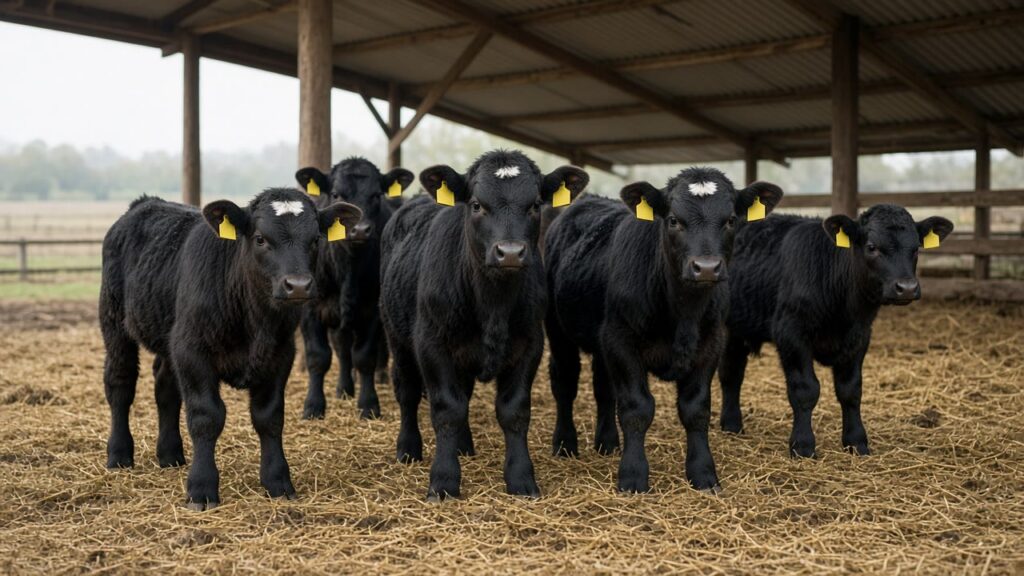
Angus cross calves are among the easiest beef-from-dairy calves to place with a rearing farm, but only when the lot is described well enough for the buyer to know what is actually on the truck. “Angus cross” on its own says which bull was used. It says nothing about the dam, the age spread or how the calves were fed, and those are the points a foreign buyer checks before agreeing a lot.
Below is the buyer’s side: what we ask a seller to state and what makes a lot uniform. For the breed itself, our page on Aberdeen Angus cattle covers type, temperament and typical use.
Why buyers ask for Angus cross calves
Angus is a medium-framed, early-maturing British breed. Used on dairy cows, it gives a calf with a clear beef purpose, a quiet temperament and a tendency to finish steadily on forage-based rations. The animals are naturally polled in most cases, which removes dehorning work, and they are easy to handle in groups.
That is the appeal for a fattening farm in Poland. An Angus cross is not bought for the heaviest possible carcass; continental sires such as Limousin, Charolais or Belgian Blue are the choice there. It is bought for consistency and ease. That is why repeat lots of the same cross suit a buyer better than a one-off mix.
If you are weighing Angus against other sires, our side-by-side comparison of the main cross sires sets them out by weight class and buyer type.
The dam breed matters as much as the sire
The most common gap in an Angus offer is the dam. An Angus × Holstein Friesian calf, an Angus × Fleckvieh calf and a purebred Angus calf behave differently in a feeding plan. Frame, growth curve and finishing weight all shift with the mother, so the buyer needs to know which dairy or beef breed is behind each calf.
Where a lot comes from one dairy herd, the answer is usually simple: one dam breed, one sire breed. Lots gathered from several farms by a trader need more care. If dams differ, count each group and state it, for example “18 Angus × Holstein bulls, 10 Angus × Fleckvieh bulls”. A lot labelled only “Angus cross, mixed” is hard to place.
Colour and horn status help, but only as a first check. Most Angus-sired calves are black or black with white markings and polled, yet a red calf or one with scurs can still be Angus-sired, and a black polled calf is not proof of Angus breeding. Mention it if colour or horn status varies within the lot; buyers prefer to hear it in the offer rather than at the loading ramp. Our page on beef-dairy crossbreeds explains how we describe crosses in general.
What makes an Angus cross lot uniform
Uniformity is the single most useful quality in a lot. A rearer fills a pen or a shed with one group and feeds it as one group. Calves that differ widely in age or rearing history do not do well together.
We look at four things:
- Age and weight spread. A narrow window within the weight class is better than a wide one. Our indicative bands are 52–90 kg for dairy calves, 110–150 kg for starter calves and 220–350 kg for weaned or stocker calves of beef breeds. These are guide ranges only; the exact spec is agreed per lot.
- Sex split. Bulls and heifers are usually reared for different purposes, so state the numbers of each.
- Rearing history. Whether calves were on milk replacer, weaned, housed together or bought in from several farms.
- Health history. Treatments and vaccinations given, as recorded on the farm, and anything the official veterinarian should know before certification.
A short table with ear-tag number, date of birth, sex, dam breed and weight answers most of the buyer’s questions in one message.
Papers and loading for an Angus cross lot
The documents are the same as for any calf moving within the EU. Every animal must carry its ear tags and have a bovine passport or identification document. Where the national database records the sire breed, it is worth checking that it matches what the offer says, because it is the first thing a buyer compares.
Before dispatch, the official veterinarian in the country of origin issues the EU animal health certificate for intra-Union trade in TRACES NT, under Delegated Regulation (EU) 2020/688. No calves are loaded before that certificate exists. Transport follows Council Regulation (EC) No 1/2005: authorised transporter, approved vehicle, certified driver and a journey log on long journeys. Sources: EUR-Lex and the European Commission, as of 5 November 2026.
On our side, the price basis is EXW. We collect the calves at your farm or collection point with our own trucks, so the seller does not need to organise transport. Minimum lots are 28 head for TYPE 1 transport (up to 8 hours’ drive) and 150 head for TYPE 2 long-distance transport by trailer. The price per head is agreed per lot and paid in EUR; there is no published price list. Our page on how we buy calves sets out the terms in full.
Where Angus-sired calves come from
Angus-sired calves are widely available from dairy herds in Ireland, and they also appear in lots from the Netherlands, Germany and France. Each supplier country has its own page with the certifying authority and the local paperwork; start with buying calves from Ireland or the full list of supplier countries.
For more on how Irish calves reach Polish farms, read our notes on the Irish calf trade with Poland.
Offering Angus cross calves to a Polish buyer
A good first message is short and complete. Include the country and region, sire and dam breed, number of head, sex split, age and weight range, feeding and health history, ear-tag numbers, the documents ready and the week you can load. With a new supplier we usually start with a trial lot, and payment and trial terms are agreed before the first loading.
Euro Cieleta buys Angus and Angus-cross calves for rearing and finishing farms in Poland, and regular lots of the same cross are the kind of cooperation we look for. You can send your lot through the supplier form, read how supplier partnerships work, or check the common questions from sellers first. By phone or WhatsApp: +48 691 900 728. By email: biuro@eurocieleta.pl.